The Hidden Math Behind Wealth: What Is the Formula to Find Compound Interest?
Albert Einstein allegedly called compound interest the "eighth wonder of the world," a force that turns modest savings into fortunes over time. Yet, for all its power, the mechanics behind what is the formula to find compound interest remain shrouded in ambiguity for many. The formula isn’t just a mathematical abstraction—it’s the blueprint for exponential growth, whether in savings accounts, retirement funds, or even the valuation of businesses. Understanding it isn’t optional; it’s a prerequisite for anyone seeking financial literacy beyond basic arithmetic.
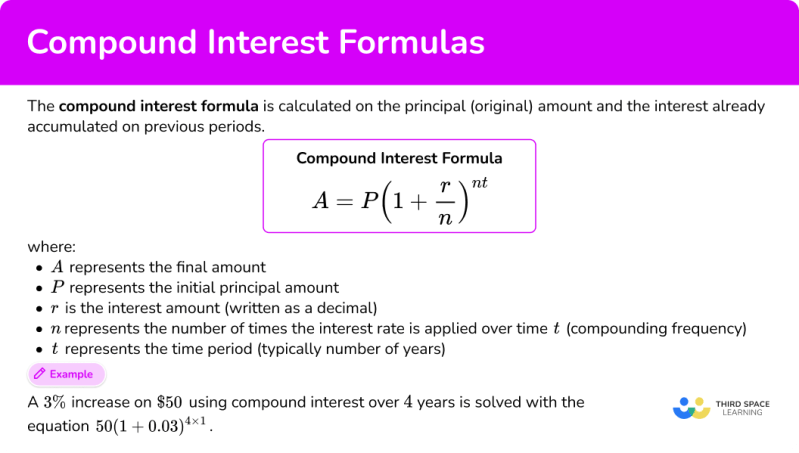
The formula itself is deceptively simple: A = P(1 + r/n)^(nt), where A represents the future value, P the principal, r the annual interest rate, n the number of compounding periods per year, and t the time in years. But simplicity belies depth. The variables interact in ways that defy linear intuition—doubling the rate doesn’t double the return; it compounds it. This is why a 7% annual return over 30 years yields over 760% growth, while a 14% return (double the rate) yields just over 1,500%—a 97% difference. The formula isn’t just about numbers; it’s about leverage.
What separates savers from investors, debtors from creditors, is often this one equation. A bank teller might calculate simple interest without blinking, but a Warren Buffett studies compounding tables to outmaneuver markets. The formula to find compound interest isn’t just a tool—it’s a lens through which to view time, risk, and opportunity costs. Below, we dissect its origins, mechanics, and why mastering it could redefine your financial trajectory.

The Complete Overview of What Is the Formula to Find Compound Interest
The formula to find compound interest—A = P(1 + r/n)^(nt)—is the cornerstone of modern finance, yet its implications extend beyond spreadsheets into philosophy. At its core, it quantifies how money grows when interest is reinvested periodically, creating a snowball effect. The variables aren’t arbitrary: P (principal) is your starting capital; r (rate) reflects the cost of borrowed money or the reward for lending; n (compounding frequency) determines how often interest is calculated (annually, monthly, daily); and t (time) is the multiplier that turns small inputs into large outputs. The exponent nt is where the magic happens, transforming linear time into exponential returns.Misapplying the formula can lead to catastrophic errors. For example, a loan amortization schedule relies on precise compounding calculations—misalign n or r, and payments spiral out of control. Similarly, retirement planners who underestimate t (e.g., assuming 20 years instead of 30) risk running out of funds. The formula isn’t just a calculation; it’s a risk-management tool. Financial institutions exploit it to structure mortgages, credit cards, and annuities, while individuals use it to optimize savings, college funds, or early retirement strategies. The key insight? Compound interest isn’t just about earning money—it’s about preserving and amplifying it over decades.
Historical Background and Evolution
The concept of compound interest predates recorded history, emerging in ancient Mesopotamia where merchants used clay tablets to track loans with interest. The Babylonians (circa 2000 BCE) charged interest rates as high as 33%, but their calculations were rudimentary—no formalized compounding formula existed. By the 12th century, Islamic scholars like Al-Khwarizmi (the "father of algebra") formalized interest calculations in their treatises, though religious prohibitions on usury stifled widespread adoption in the Middle East.The modern formula to find compound interest took shape in 17th-century Europe, as merchants and mathematicians sought to standardize financial transactions. Luca Pacioli, the "father of accounting," documented compound interest in his 1494 treatise Summa de Arithmetica, but it was Swiss mathematician Jacob Bernoulli who later proved its exponential nature in the 1680s. The Industrial Revolution accelerated its use, as banks and insurance companies needed precise tools to price long-term loans and annuities. By the 20th century, the formula became a staple of corporate finance, with economists like Irving Fisher refining its application to inflation-adjusted returns. Today, it underpins everything from index funds to cryptocurrency staking rewards.
Core Mechanisms: How It Works
The formula to calculate compound interest operates on two principles: reinvestment and time decay. Reinvestment means that interest earned in each period generates its own interest in subsequent periods. For instance, if you deposit $1,000 at 5% annual interest compounded yearly, after 1 year you earn $50, bringing your total to $1,050. In Year 2, the 5% is applied to $1,050, yielding $52.50—$2.50 more than if the first $50 had been withdrawn. This "interest on interest" effect accelerates over time, creating a geometric progression.Table of Contents
- The Complete Overview of What Is the Formula to Find Compound Interest
- Historical Background and Evolution
- Core Mechanisms: How It Works
- Key Benefits and Crucial Impact
- Major Advantages
- Comparative Analysis
- Future Trends and Innovations
- Conclusion
- Comprehensive FAQs
- Q: How do I calculate compound interest manually without a calculator?
- Q: Why does compounding frequency ( n ) matter so much?
- Q: Can compound interest work against me?
- Q: How does inflation affect compound interest calculations?
- Q: What’s the difference between compound interest and "rule of 72"?
- Q: Can I use compound interest for debt repayment?
- Q: Are there any real-world examples where compound interest fails?
Time decay refers to the diminishing returns of waiting. The longer you compound, the more the exponent nt amplifies the result. A $10,000 investment at 8% compounded annually grows to $46,609 in 20 years but leaps to $215,892 in 30 years—a 360% increase in just a decade. This is why financial advisors emphasize starting early: the formula rewards patience exponentially. The frequency of compounding (n) also plays a critical role. Daily compounding (e.g., credit cards) can trap borrowers in high-interest cycles, while monthly compounding (e.g., savings accounts) offers a slower but steadier growth path.
Key Benefits and Crucial Impact
Understanding how to find compound interest isn’t just academic—it’s a survival skill in an economy where inflation erodes purchasing power and retirement spans 30+ years. The formula transforms passive savings into active wealth-building, provided you align the variables correctly. A 22-year-old investing $500 monthly at 7% compounded monthly could retire with over $1 million by 65, while someone starting at 35 would need to save $1,500 monthly to match the same outcome. The formula doesn’t just calculate returns; it exposes the cost of delay.The psychological impact is equally profound. Compound interest turns abstract concepts like "opportunity cost" into tangible losses. For example, a $10,000 investment missed due to procrastination could cost $50,000 in foregone growth over 20 years at 7%. Conversely, it incentivizes disciplined habits—automated savings, tax-advantaged accounts, and diversified portfolios—all of which compound over time. The formula is a mirror: it reflects not just your capital, but your patience, consistency, and foresight.
"Compound interest is the most powerful force in the universe." — Charlie Munger, Vice Chairman of Berkshire Hathaway
Major Advantages
- Exponential Growth Over Time: The formula’s exponential nature means that even modest contributions (e.g., $200/month) can grow into six-figure sums over 30 years at market returns (historically ~10%).
- Leverage Against Inflation: By outpacing inflation (typically 2–3%), compound interest preserves real purchasing power, unlike stagnant savings accounts.
- Tax-Deferred Compounding: Accounts like 401(k)s or IRAs allow interest to compound without annual tax deductions, accelerating growth by reducing drag.
- Debt Destruction Tool: Applied to mortgages or loans, the formula reveals how aggressive payments (increasing n) can slash interest costs by decades.
- Behavioral Anchor: Visualizing compounding effects (e.g., via calculators) reinforces long-term discipline, countering short-term emotional spending.
Comparative Analysis
| Metric | Compound Interest | Simple Interest |
|---|---|---|
| Formula | A = P(1 + r/n)^(nt) |
A = P(1 + rt) |
| Growth Rate | Exponential (accelerates over time) | Linear (fixed annual return) |
| Best For | Long-term investments (retirement, stocks) | Short-term loans (certificates of deposit) |
| Risk Factor | Higher potential returns but volatile (market-dependent) | Predictable but lower yields |
Future Trends and Innovations
The formula to find compound interest is evolving alongside technology. Blockchain and decentralized finance (DeFi) platforms are introducing continuous compounding—where interest is calculated and reinvested in real-time, eliminating n’s discrete periods. Protocols like Aave or Compound Finance use algorithms to automate reinvestment, offering yields that exceed traditional savings accounts. Meanwhile, robo-advisors leverage the formula to optimize portfolios dynamically, adjusting r and n based on market conditions.Artificial intelligence is poised to personalize compounding strategies further. AI-driven tools could simulate thousands of P, r, and t combinations to recommend bespoke savings or debt-repayment plans. For example, an AI might suggest increasing n (frequent contributions) during high-interest-rate periods or shifting P (principal) to higher-yield assets like real estate crowdfunding. The future of compound interest isn’t just about the formula—it’s about making it adaptive, accessible, and autonomous.

Conclusion
The formula to calculate compound interest is more than a financial tool—it’s a paradigm shift in how we think about time and money. It exposes the hidden costs of delay, the power of consistency, and the nonlinear rewards of patience. Whether you’re a saver, investor, or borrower, mastering this formula isn’t optional; it’s a prerequisite for navigating an economy where wealth compounds as surely as interest does. The variables are within your control: P through savings, r through asset selection, n through frequency, and t through discipline. Ignore them, and you’re at the mercy of inflation and short-term thinking. Harness them, and you’re building a legacy.The irony? The formula itself hasn’t changed in centuries. What has changed is our ability to exploit it—through technology, automation, and global markets. The next decade will belong to those who treat compound interest not as a passive benefit but as an active strategy. Start now, and the formula will work for you. Wait, and it will work against you.
Comprehensive FAQs
Q: How do I calculate compound interest manually without a calculator?
A: Use the formula step-by-step:
1. Divide the annual rate (r) by n (e.g., 6% annually compounded monthly = 0.06/12 = 0.005).
2. Add 1 to the result (1.005).
3. Raise this to the power of nt (e.g., 1.005^(12×5) for 5 years).
4. Multiply by P (principal). For example, $1,000 at 6% monthly for 5 years: 1,000 × (1.005)^60 ≈ $1,348.85.
Q: Why does compounding frequency (n) matter so much?
A: Higher n (e.g., daily vs. annual) increases the exponent nt, accelerating growth. For instance, $1,000 at 10% for 10 years compounds to $2,707 annually but $2,755 daily—a 1.8% difference. Credit cards exploit daily compounding to maximize debt, while savings accounts use monthly to minimize payouts.
Q: Can compound interest work against me?
A: Absolutely. Credit cards, payday loans, and subprime mortgages use aggressive compounding (n = 365) to trap borrowers. A $5,000 balance at 20% APR compounded daily could grow to $7,340 in a year—without adding a penny. Always check n in loan agreements.
Q: How does inflation affect compound interest calculations?
A: Inflation erodes the real value of compounded returns. To adjust, subtract the inflation rate from r (nominal rate). For example, a 7% return with 3% inflation yields a 4% real return. Use the formula with r = 0.04 to see true growth.
Q: What’s the difference between compound interest and "rule of 72"?
A: The rule of 72 is a shortcut to estimate how long it takes for an investment to double: divide 72 by the interest rate (r). For example, 72/8% = 9 years to double. It’s derived from logarithms of the compounding formula but ignores n and P, making it less precise for long-term planning.
Q: Can I use compound interest for debt repayment?
A: Yes. Treat your debt principal (P) as negative and apply the formula to see how extra payments reduce t. For example, paying $200 extra monthly on a $30,000 loan at 5% could save $12,000 in interest and 5 years of payments.
Q: Are there any real-world examples where compound interest fails?
A: Hyperinflationary economies (e.g., Zimbabwe, Venezuela) distort r to negative values, making compounding meaningless. Also, in zero-interest-rate environments (e.g., Japan’s 2010s), r approaches 0, halting growth entirely.
Leave a Comment
Comments are moderated before appearing. The data you submit is processed according to the Privacy Policy of kiwiirc.com.