The Definitive Guide to the List of All Perfect Square Roots
Mathematics is a language of precision, where numbers and operations form the foundation of logic and problem-solving. Among its most fundamental concepts, the list of all perfect square roots stands as a cornerstone—an elegant intersection of integers and irrationality. These roots, derived from squaring whole numbers, reveal patterns that have fascinated mathematicians for millennia, from ancient geometric proofs to modern computational algorithms. Yet, despite their simplicity, they hold profound implications in algebra, cryptography, and even physics, where square roots govern everything from wave functions to structural engineering.
The beauty of perfect square roots lies in their duality: they are both finite and infinite. While the square root of 1 is a neat 1.0, the square root of 2 introduces irrationality—a concept that challenged the Greeks and still underpins contemporary mathematics. This tension between exactness and complexity makes the list of all perfect square roots a subject of enduring study, bridging elementary arithmetic and advanced theoretical research. Whether you're a student grappling with quadratic equations or a researcher exploring Diophantine equations, understanding these roots is essential.
At its core, the list of all perfect square roots is more than a sequence of numbers; it’s a gateway to deeper mathematical truths. From Pythagoras’ theorem to the golden ratio, these roots appear in unexpected places, influencing fields as diverse as computer science and art. Below, we dissect their origins, mechanics, and real-world impact—providing a definitive resource for anyone seeking clarity on this foundational topic.
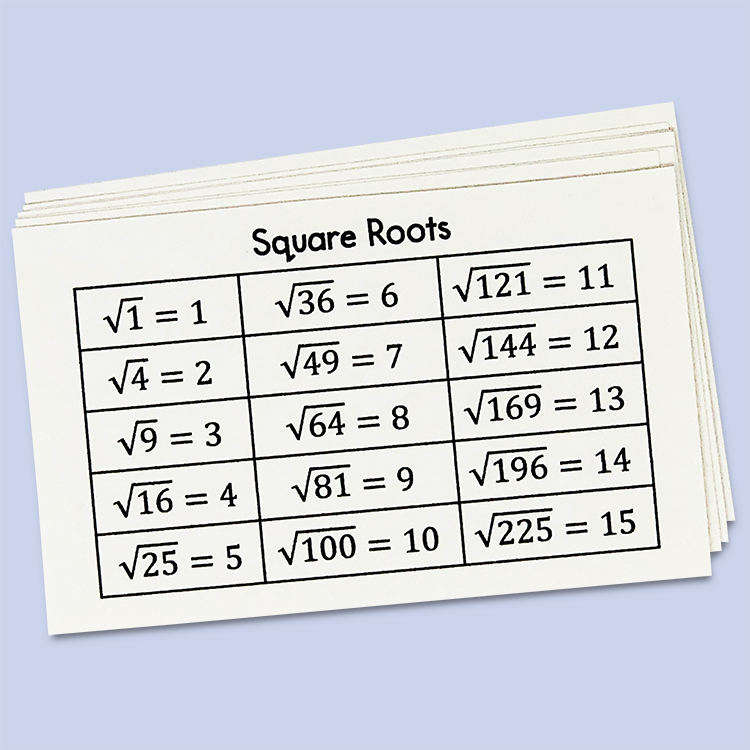
The Complete Overview of the List of All Perfect Square Roots
The list of all perfect square roots refers to the square roots of perfect squares—integers that result from squaring another integer. For example, 9 is a perfect square because it equals 3², and its square root, 3, is an integer. This property distinguishes perfect squares from non-perfect squares (e.g., 10, whose square root is approximately 3.162, an irrational number). The sequence of perfect square roots is infinite, generated by squaring every positive integer (1, 2, 3, ...) and taking their roots. While the list itself is straightforward, its implications ripple across mathematics, from solving polynomial equations to optimizing algorithms in computational theory.What makes this list particularly intriguing is its role as a bridge between discrete and continuous mathematics. On one hand, perfect square roots are discrete—each corresponds to a unique integer. On the other, their irrational counterparts (like √2 or √3) introduce infinite, non-repeating decimals, illustrating the contrast between order and chaos in numbers. This duality is not just academic; it has practical applications in fields like cryptography, where prime numbers and their square roots are used to secure digital communications. Understanding the list of all perfect square roots thus requires appreciating both its simplicity and its broader mathematical context.
Historical Background and Evolution
The study of square roots dates back to ancient Babylonian mathematics, where clay tablets from around 1800 BCE contain tables of square roots and reciprocal values. These early mathematicians recognized that certain numbers, when squared, yielded other integers—a concept later formalized by the Greeks. Pythagoras and his followers, in particular, were obsessed with perfect squares, as they underpinned their geometric proofs, especially in the famous Pythagorean theorem (a² + b² = c²). The theorem’s reliance on perfect squares cemented their importance in both pure and applied mathematics.The formalization of perfect square roots as a distinct mathematical entity, however, emerged during the Renaissance. Mathematicians like Fibonacci and later Descartes expanded on algebraic methods, demonstrating how square roots could be used to solve quadratic equations. The 17th century saw further advancements with the introduction of coordinate geometry by René Descartes, where square roots became essential for plotting parabolas and other curves. Meanwhile, the discovery of irrational numbers—square roots of non-perfect squares—by the Pythagoreans (e.g., √2) forced a reevaluation of mathematical foundations, leading to the development of real numbers and calculus. Today, the list of all perfect square roots remains a touchstone for understanding these historical breakthroughs.
Core Mechanisms: How It Works
The generation of perfect square roots is a fundamental arithmetic operation. For any positive integer n, the perfect square is n², and its square root is n. This relationship is expressed algebraically as:√(n²) = n, where n is an integer. The process is iterative: start with 1, square it to get 1, take its square root (1), then move to 2, square it to get 4, and so on. The result is an infinite sequence: 1, 2, 3, 4, 5, ..., corresponding to the square roots of 1, 4, 9, 16, 25, etc.
Table of Contents
- The Complete Overview of the List of All Perfect Square Roots
- Historical Background and Evolution
- Core Mechanisms: How It Works
- Key Benefits and Crucial Impact
- Major Advantages
- Comparative Analysis
- Future Trends and Innovations
- Conclusion
- Comprehensive FAQs
- Q: What defines a perfect square root?
- Q: Are there any negative perfect square roots?
- Q: How can I generate the list of all perfect square roots up to a given number?
- Q: Why are perfect square roots important in cryptography?
- Q: Can the list of all perfect square roots be infinite?
- Q: How do perfect square roots relate to Pythagoras’ theorem?
- Q: Are there any real-world applications beyond mathematics?
The key insight is that perfect square roots are always integers, whereas square roots of non-perfect squares are either irrational (e.g., √3 ≈ 1.732) or rational but non-integer (e.g., √(1/4) = 0.5). This distinction is critical in number theory, where perfect squares are used to classify integers and solve Diophantine equations (equations seeking integer solutions). For instance, Fermat’s Last Theorem, which states that no three positive integers a, b, and c satisfy aⁿ + bⁿ = cⁿ for n > 2, relies heavily on properties of perfect squares and their roots. The mechanics of this list thus extend beyond basic arithmetic into advanced theoretical mathematics.
Key Benefits and Crucial Impact
The list of all perfect square roots is not merely an academic curiosity; it serves as a foundational tool in numerous scientific and engineering disciplines. In computer science, for example, algorithms often rely on perfect squares for optimization, such as in sorting networks or cryptographic hashing functions. Engineers use square roots to calculate forces, stresses, and dimensions in structural designs, where precision is paramount. Even in finance, perfect squares appear in option pricing models, where the Black-Scholes equation involves square root functions to determine volatility.Beyond practical applications, the list plays a pivotal role in mathematical proofs and theorems. The Fundamental Theorem of Arithmetic, which states that every integer greater than 1 has a unique prime factorization, depends on the properties of perfect squares. Similarly, the concept of quadratic residues—numbers that are perfect squares modulo a prime—relies on the list of all perfect square roots to classify integers in modular arithmetic. This interplay between theory and application underscores why mastering this list is essential for both students and professionals.
"Mathematics is the music of reason." — James Joseph Sylvester
The harmony of perfect square roots lies in their ability to connect abstract theory with tangible results, much like music bridges emotion and structure.
Major Advantages
- Simplification of Equations: Perfect square roots allow for exact solutions in quadratic equations, avoiding approximations that arise with irrational roots.
- Algorithmic Efficiency: Many computational algorithms leverage perfect squares for faster calculations, reducing complexity in tasks like matrix operations.
- Geometric Applications: Square roots are essential in trigonometry and coordinate geometry, enabling precise measurements in physics and engineering.
- Number Theory Foundations: The list underpins proofs in Diophantine analysis, prime number theory, and cryptographic protocols.
- Educational Clarity: Teaching perfect square roots provides a clear entry point into advanced topics like irrational numbers and calculus.

Comparative Analysis
| Perfect Square Roots | Non-Perfect Square Roots |
|---|---|
| Always integers (e.g., √16 = 4). | Often irrational (e.g., √2 ≈ 1.414). |
| Used in exact calculations (e.g., geometry, algebra). | Require approximations (e.g., physics, statistics). |
| Infinite but countable sequence. | Infinite and uncountable (real numbers). |
| Critical in number theory proofs. | Essential in calculus and analysis. |
Future Trends and Innovations
As mathematics continues to evolve, the list of all perfect square roots will remain relevant in emerging fields like quantum computing and machine learning. Quantum algorithms, for instance, often rely on square roots for state transformations, while neural networks use them in optimization functions. Additionally, advancements in computational number theory may uncover new properties of perfect squares, particularly in cryptography, where post-quantum algorithms could leverage their unique characteristics to enhance security.Another frontier is the intersection of perfect squares with fractal geometry and chaos theory. While perfect square roots themselves are orderly, their irrational counterparts appear in chaotic systems, suggesting deeper connections between structure and randomness. Future research may explore how these roots can model complex phenomena, from stock market fluctuations to biological growth patterns. As technology advances, the practical applications of perfect square roots will likely expand, cementing their status as a timeless mathematical tool.

Conclusion
The list of all perfect square roots is a testament to the elegance and utility of mathematics. From ancient geometric proofs to modern computational algorithms, these roots have shaped the way we understand numbers and their relationships. Their simplicity belies their depth, offering exact solutions where other methods falter and serving as a gateway to more complex mathematical concepts. Whether you're solving a quadratic equation or designing a cryptographic system, this list provides the foundation for precision and innovation.As we look to the future, the study of perfect square roots will continue to intersect with cutting-edge fields, from quantum mechanics to artificial intelligence. By mastering this list, mathematicians, engineers, and scientists equip themselves with a powerful tool—one that transcends disciplines and remains indispensable in an ever-evolving world of discovery.
Comprehensive FAQs
Q: What defines a perfect square root?
A perfect square root is the square root of a perfect square, meaning it is an integer. For example, √25 = 5, where 25 is a perfect square (5²), and 5 is an integer. Non-perfect squares (e.g., 10) yield irrational or non-integer roots.
Q: Are there any negative perfect square roots?
Yes, but they are typically considered in the context of signed integers. For example, √9 can be +3 or -3, since both (-3)² = 9 and 3² = 9. However, the principal (non-negative) square root is conventionally used in most mathematical contexts.
Q: How can I generate the list of all perfect square roots up to a given number?
To generate the list of all perfect square roots up to n, iterate through integers from 1 to √n and square each. For example, to list perfect square roots up to 100, compute 1², 2², ..., 10² (since 10² = 100). The roots are 1 through 10.
Q: Why are perfect square roots important in cryptography?
Perfect square roots are used in cryptographic algorithms like RSA encryption, where large primes and their squares are manipulated to secure data. The difficulty of factoring large numbers (which involves finding square roots of products) forms the basis of many encryption schemes.
Q: Can the list of all perfect square roots be infinite?
Yes, the list is infinite because there are infinitely many integers. For every positive integer n, there exists a perfect square (n²) and its corresponding integer square root (n). This contrasts with irrational square roots, which are also infinite but non-repeating.
Q: How do perfect square roots relate to Pythagoras’ theorem?
Pythagoras’ theorem states that in a right-angled triangle, the square of the hypotenuse (c) equals the sum of the squares of the other two sides (a and b): a² + b² = c². The lengths a, b, and c are often perfect squares or involve square roots, making perfect square roots essential for verifying triangle dimensions.
Q: Are there any real-world applications beyond mathematics?
Yes, perfect square roots appear in physics (e.g., calculating distances in space), engineering (e.g., stress analysis in materials), and even music (e.g., tuning frequencies based on harmonic ratios). Their precision makes them invaluable in any field requiring exact measurements.
Leave a Comment
Comments are moderated before appearing. The data you submit is processed according to the Privacy Policy of kiwiirc.com.